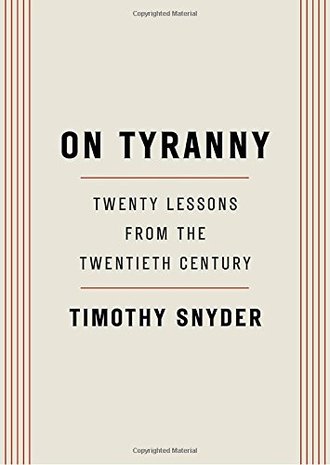
Find the #1 NYT Bestseller On Tyranny by Timothy Snyder from your local library.
Click Check on Amazon to read book reviews on Amazon. Click Google Preview to read chapters from Google Books if available. Click Find in Library to check book availability at your local library. If the default library is not correct, follow Change Local Library to reset it.
On Tyranny
#1 NEW YORK TIMES BESTSELLER • A “bracing” (Vox) guide for surviving and resisting America’s turn towards authoritarianism, from “a rising public intellectual unafraid to make bold connections between past and present” (The New York Times) “Timothy Snyder reasons with unparalleled clarity, throwing the past and future into sharp relief. He has written the rare kind of book that can be read in one sitting but will keep you coming back to help regain your bearings.”—Masha Gessen The Founding Fathers tried to protect us from the threat they knew, the tyranny that overcame ancient democracy. Today, our political order faces new threats, not unlike the totalitarianism of the twentieth century. We are no wiser than the Europeans who saw democracy yield to fascism, Nazism, or communism. Our one advantage is that we might learn from their experience. On Tyranny is a call to arms and a guide to resistance, with invaluable ideas for how we can preserve our freedoms in the uncertain years to come.
More books by Timothy Snyder
1. On Freedom
A brilliant exploration of freedom—what it is, how it’s been misunderstood, and why it’s our only chance for survival—by the acclaimed Yale historian and author of the #1 New York Times bestseller On Tyranny “Much like life itself, freedom needs to be defined and redefined. On Freedom offers fresh insight into essential aspects of human existence—the values and obligations inherent in every individual’s life.”—Ai Weiwei Timothy Snyder has been called “the leading interpreter of our dark times.” As a historian, he has given us startling reinterpretations of political collapse and mass killing. As a public intellectual, he has turned that knowledge toward counsel and prediction, working against authoritarianism here and abroad. His book On Tyranny has inspired millions around the world to fight for freedom. Now, in this tour de force of political philosophy, he helps us see exactly what we’re fighting for. Freedom is the great American commitment, but as Snyder argues, we have lost sight of what it means—and this is leading us into crisis. Too many of us look at freedom as the absence of state power: We think we’re free if we can do and say as we please, and protect ourselves from government overreach. But true freedom isn’t so much freedom from as freedom to—the freedom to thrive, to take risks for futures we choose by working together. Freedom is the value that makes all other values possible. On Freedom takes us on a thrilling intellectual journey. Drawing on the work of philosophers and political dissidents, conversations with contemporary thinkers, and his own experiences coming of age in a time of American exceptionalism, Snyder identifies the practices and attitudes—the habits of mind—that will allow us to design a government in which we and future generations can flourish. We come to appreciate the importance of traditions (championed by the right) but also the role of institutions (the purview of the left). Intimate yet ambitious, this book helps forge a new consensus rooted in a politics of abundance, generosity, and grace.
2. The Flexible Budget
Ditch the Averages, Embrace Control: Your Guide to The Flexible Budget Feeling overwhelmed by budgeting advice that doesn’t fit your life? The Flexible Budget is your answer. This practical guide empowers you to build a personalized spending plan that works for you, not the other way around. Forget about unrealistic “average” salaries and one-size-fits-all approaches. Here, you’ll learn how to: Track your spending: Understand where your money goes before creating a budget. Embrace the 70/20/10 Framework (with a twist): Use this popular method as a flexible guide, not a rigid rule. Adapt it to your income and needs for essentials, wants, and savings/debt repayment. Craft a budget that reflects your reality: High rent? No problem! We’ll help you adjust other categories to make it work. Conquer debt: Tackle high-interest debt and create a plan for financial freedom. Build a safety net: Learn strategies for building an emergency fund and saving for your future. The Flexible Budget is packed with actionable tips, real-world examples, and helpful tools to take control of your finances. Stop the money stress and start living life on your terms! Bonus: Learn how to: Automate your finances for effortless progress. Review and adjust your budget as your life evolves. Celebrate your milestones and stay motivated on your financial journey. The Flexible Budget is your key to financial confidence and a brighter future. Start building a budget that works for you today!
3. Our Malady
NEW YORK TIMES BESTSELLER • From the author of the #1 New York Times bestseller On Tyranny comes an impassioned condemnation of America’s pandemic response and an urgent call to rethink health and freedom. On December 29, 2019, historian Timothy Snyder fell gravely ill. Unable to stand, barely able to think, he waited for hours in an emergency room before being correctly diagnosed and rushed into surgery. Over the next few days, as he clung to life and the first light of a new year came through his window, he found himself reflecting on the fragility of health, not recognized in America as a human right but without which all rights and freedoms have no meaning. And that was before the pandemic. We have since watched American hospitals, long understaffed and undersupplied, buckling under waves of ill patients. The federal government made matters worse through willful ignorance, misinformation, and profiteering. Our system of commercial medicine failed the ultimate test, and thousands of Americans died. In this eye-opening cri de coeur, Snyder traces the societal forces that led us here and outlines the lessons we must learn to survive. In examining some of the darkest moments of recent history and of his own life, Snyder finds glimmers of hope and principles that could lead us out of our current malaise. Only by enshrining healthcare as a human right, elevating the authority of doctors and medical knowledge, and planning for our children’s future can we create an America where everyone is truly free.
4. The Road To Unfreedom
NEW YORK TIMES BESTSELLER • From the author of On Tyranny comes a stunning new chronicle of the rise of authoritarianism from Russia to Europe and America. “A brilliant analysis of our time.”—Karl Ove Knausgaard, The New Yorker With the end of the Cold War, the victory of liberal democracy seemed final. Observers declared the end of history, confident in a peaceful, globalized future. This faith was misplaced. Authoritarianism returned to Russia, as Vladimir Putin found fascist ideas that could be used to justify rule by the wealthy. In the 2010s, it has spread from east to west, aided by Russian warfare in Ukraine and cyberwar in Europe and the United States. Russia found allies among nationalists, oligarchs, and radicals everywhere, and its drive to dissolve Western institutions, states, and values found resonance within the West itself. The rise of populism, the British vote against the EU, and the election of Donald Trump were all Russian goals, but their achievement reveals the vulnerability of Western societies. In this forceful and unsparing work of contemporary history, based on vast research as well as personal reporting, Snyder goes beyond the headlines to expose the true nature of the threat to democracy and law. To understand the challenge is to see, and perhaps renew, the fundamental political virtues offered by tradition and demanded by the future. By revealing the stark choices before us–between equality or oligarchy, individuality or totality, truth and falsehood–Snyder restores our understanding of the basis of our way of life, offering a way forward in a time of terrible uncertainty.
5. Nationalism, Marxism, and Modern Central Europe
Timothy Snyder opens a new path in the understanding of modern nationalism and twentieth-century socialism by presenting the often overlooked life of Kazimierz Kelles-Krauz, an important Polish thinker at the beginning of the twentieth century. During his brief life in Poland, Paris, and Vienna, Kelles-Krauz influenced or infuriated most of the leaders of the various socialist movements of Central Europe and France. His central ideas ultimately were not accepted by the socialist mainstream at the time of his death. However, a century later, we see that they anticipated late twentieth-century understanding on the importance of nationalism as a social force and the parameters of socialism in political theory and praxis. Kelles-Krauz was one of the only theoreticians of his age to advocate Jewish national rights as being equivalent to, for example, Polish national rights, and he correctly saw the struggle for national sovereignty as being central to future events in Europe. This was the first major monograph in English devoted to Kelles-Krauz, and it includes maps and personal photographs of Kelles-Krauz, his colleagues, and his family.
6. That College Book
In high school, everyone’s talking about college. What to do. Where to go. Why it’s important. Classes are given on it. Books are written about it. But details get left out. Every year, college graduates learn this the hard way as they step into adulthood. I was one of them. After earning a four-year degree, I went through two of the worst years of my life. Not that my situation is unique. I am a part of a generation that was told to go to college first and sort out the details later. Most of us did. We chased the promise of a big shiny future, and we ended up being chased by the mistakes of our past. That’s not to say we completely regretted going. This book isn’t a list of privileged millennial complaints. It’s a collection of wisdom gained in less than pleasant ways. It’s a story of hardship, failure, victory, and perseverance. It’s all of the things we wish someone had told us. And it takes place before college, in college, after college, and without college. This is the wild, painful, awkward, hilarious, depressing, & beautiful journey from youth to maturity. This is the college book that no one ever gave us.
7. Black Earth
NEW YORK TIMES BESTSELLER • “[Timothy] Snyder identifies the conditions that allowed the Holocaust—conditions our society today shares. . . . He certainly couldn’t be more right about our world.”—The New Republic A “gripping [and] disturbingly vivid” (The Wall Street Journal) portrait of the defining tragedy of our time, from the #1 New York Times bestselling author of On Tyranny ONE OF THE BEST BOOKS OF THE YEAR—The Washington Post, The Economist, Publishers Weekly In this epic history of extermination and survival, Timothy Snyder presents a new explanation of the great atrocity of the twentieth century, and reveals the risks that we face in the twenty-first. Based on untapped sources from eastern Europe and forgotten testimonies from Jewish survivors, Black Earth recounts the mass murder of the Jews as an event that is still close to us, more comprehensible than we would like to think and thus all the more terrifying. By overlooking the lessons of the Holocaust, Snyder concludes, we have misunderstood modernity and endangered the future. The early twenty-first century is coming to resemble the early twentieth, as growing preoccupations with food and water accompany ideological challenges to global order. Our world is closer to Hitler’s than we like to admit, and saving it requires us to see the Holocaust as it was—and ourselves as we are. Groundbreaking, authoritative, and utterly absorbing, Black Earth reveals a Holocaust that is not only history but warning. New York Times Editors’ Choice • Finalist for the Samuel Johnson Prize; the Mark Lynton History Prize; the Arthur Ross Book Award
8. Bloodlands
From the author of the international bestseller On Tyranny, the definitive history of Hitler’s and Stalin’s politics of mass killing, explaining why Ukraine has been at the center of Western history for the last century. Americans call the Second World War “the Good War.” But before it even began, America’s ally Stalin had killed millions of his own citizens—and kept killing them during and after the war. Before Hitler was defeated, he had murdered six million Jews and nearly as many other Europeans. At war’s end, German and Soviet killing sites fell behind the Iron Curtain, leaving the history of mass killing in darkness. Assiduously researched, deeply humane, and utterly definitive, Bloodlands is a new kind of European history, presenting the mass murders committed by the Nazi and Stalinist regimes as two aspects of a single story. With a new afterword addressing the relevance of these events to the contemporary decline of democracy, Bloodlands is required reading for anyone seeking to understand the central tragedy of modern history and its meaning today.
9. Sketches from a Secret War
The forgotten protagonist of this true account aspired to be a cubist painter in his native Kyïv. In a Europe remade by the First World War, his talents led him to different roles—intelligence operative, powerful statesman, underground activist, lifelong conspirator. Henryk Józewski directed Polish intelligence in Ukraine, governed the borderland region of Volhynia in the interwar years, worked in the anti-Nazi and anti-Soviet underground during the Second World War, and conspired against Poland’s Stalinists until his arrest in 1953. His personal story, important in its own right, sheds new light on the foundations of Soviet power and on the ideals of those who resisted it. By following the arc of Józewski’s life, this book demonstrates that his tolerant policies toward Ukrainians in Volhynia were part of Poland’s plans to roll back the communist threat. The book mines archival materials, many available only since the fall of communism, to rescue Józewski, his Polish milieu, and his Ukrainian dream from oblivion. An epilogue connects his legacy to the disintegration of the Soviet Union and the democratic revolution in Ukraine in 2004.
10. Getting Lead-Bottomed Administrators Excited About School Library Media Centers
Gain the administrative support you need for your media center and library programs with this practical and enlightening guide. Snyder shows you how differences in background, learning styles, thought processes, leadership styles, and outlooks between school media specialists and building administrators can undermine the success of the library program. He then gives you step-by-step instructions for bridging the communication gap and leading your media center to success. The real-life examples and winning strategies are both instructive and entertaining. Essential professional reading for all media specialists.
Last updated on Sunday, November 24, 2024
 Books and Movies from Local Library