Find the #1 NYT Bestseller The Anxious Generation by Jonathan Haidt from your local library.
Click Check on Amazon to read book reviews on Amazon. Click Google Preview to read chapters from Google Books if available. Click Find in Library to check book availability at your local library. If the default library is not correct, follow Change Local Library to reset it.
The Anxious Generation
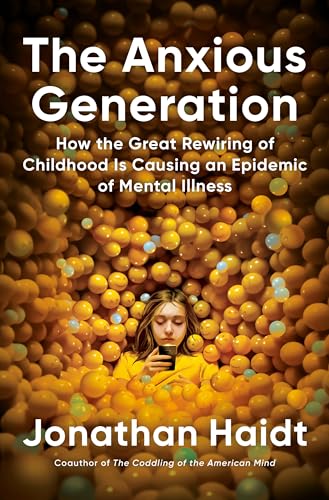 |
by: Jonathan Haidt Release date: Mar 26, 2024 Number of Pages: 401 Find in Library Check on Amazon Google Preview |
THE INSTANT #1 NEW YORK TIMES BESTSELLER • A must-read for all parents: the generation-defining investigation into the collapse of youth mental health in the era of smartphones, social media, and big tech—and a plan for a healthier, freer childhood. “With tenacity and candor, Haidt lays out the consequences that have come with allowing kids to drift further into the virtual world . . . While also offering suggestions and solutions that could help protect a new generation of kids from tech dependency, The Anxious Generation makes a dire warning.” —Shannon Carlin, TIME, 100 Must-Read Books of 2024 After more than a decade of stability or improvement, the mental health of adolescents plunged in the early 2010s. Rates of depression, anxiety, self-harm, and suicide rose sharply, more than doubling on many measures. Why? In The Anxious Generation, social psychologist Jonathan Haidt lays out the facts about the epidemic of teen mental illness that hit many countries at the same time. He then investigates the nature of childhood, including why children need play and independent exploration to mature into competent, thriving adults. Haidt shows how the “play-based childhood” began to decline in the 1980s, and how it was finally wiped out by the arrival of the “phone-based childhood” in the early 2010s. He presents more than a dozen mechanisms by which this “great rewiring of childhood” has interfered with children’s social and neurological development, covering everything from sleep deprivation to attention fragmentation, addiction, loneliness, social contagion, social comparison, and perfectionism. He explains why social media damages girls more than boys and why boys have been withdrawing from the real world into the virtual world, with disastrous consequences for themselves, their families, and their societies. Most important, Haidt issues a clear call to action. He diagnoses the “collective action problems” that trap us, and then proposes four simple rules that might set us free. He describes steps that parents, teachers, schools, tech companies, and governments can take to end the epidemic of mental illness and restore a more humane childhood. Haidt has spent his career speaking truth backed by data in the most difficult landscapes—communities polarized by politics and religion, campuses battling culture wars, and now the public health emergency faced by Gen Z. We cannot afford to ignore his findings about protecting our children—and ourselves—from the psychological damage of a phone-based life.
More books by Jonathan Haidt
1. The Coddling Of The American Mind
|
|
by: Greg Lukianoff, Jonathan Haidt Release date: Aug 20, 2019 Number of Pages: 354 Find in Library Check on Amazon Google Preview |
New York Times Bestseller • Finalist for the 2018 National Book Critics Circle Award in Nonfiction • A New York Times Notable Book • Bloomberg Best Book of 2018 • One of Bill Gates’s Top Five Books of All Time “Their distinctive contribution to the higher-education debate is to meet safetyism on its own, psychological turf . . . Lukianoff and Haidt tell us that safetyism undermines the freedom of inquiry and speech that are indispensable to universities.” —Jonathan Marks, Commentary “The remedies the book outlines should be considered on college campuses, among parents of current and future students, and by anyone longing for a more sane society.” —Pittsburgh Post-Gazette Something has been going wrong on many college campuses in the last few years. Speakers are shouted down. Students and professors say they are walking on eggshells and are afraid to speak honestly. Rates of anxiety, depression, and suicide are rising—on campus as well as nationally. How did this happen? First Amendment expert Greg Lukianoff and social psychologist Jonathan Haidt, author of The Anxious Generation, show how the new problems on campus have their origins in three terrible ideas that have become increasingly woven into American childhood and education: What doesn’t kill you makes you weaker; always trust your feelings; and life is a battle between good people and evil people. These three Great Untruths contradict basic psychological principles about well-being and ancient wisdom from many cultures. Embracing these untruths—and the resulting culture of safetyism—interferes with young people’s social, emotional, and intellectual development. It makes it harder for them to become autonomous adults who are able to navigate the bumpy road of life. Lukianoff and Haidt investigate the many social trends that have intersected to promote the spread of these untruths. They explore changes in childhood such as the rise of fearful parenting, the decline of unsupervised, child-directed play, and the new world of social media that has engulfed teenagers in the last decade. They examine changes on campus, including the corporatization of universities and the emergence of new ideas about identity and justice. They situate the conflicts on campus within the context of America’s rapidly rising political polarization and dysfunction. This is a book for anyone who is confused by what is happening on college campuses today, or has children, or is concerned about the growing inability of Americans to live, work, and cooperate across party lines.
2. The Righteous Mind
|
|
by: Jonathan Haidt Release date: Feb 12, 2013 Number of Pages: 530 Find in Library Check on Amazon Google Preview |
NEW YORK TIMES BESTSELLER • The #1 bestselling author of The Anxious Generation and acclaimed social psychologist challenges conventional thinking about morality, politics, and religion in a way that speaks to conservatives and liberals alike—a “landmark contribution to humanity’s understanding of itself” (The New York Times Book Review). Drawing on his twenty-five years of groundbreaking research on moral psychology, Jonathan Haidt shows how moral judgments arise not from reason but from gut feelings. He shows why liberals, conservatives, and libertarians have such different intuitions about right and wrong, and he shows why each side is actually right about many of its central concerns. In this subtle yet accessible book, Haidt gives you the key to understanding the miracle of human cooperation, as well as the curse of our eternal divisions and conflicts. If you’re ready to trade in anger for understanding, read The Righteous Mind.
3. The Happiness Hypothesis
|
|
by: Jonathan Haidt Release date: Jan 01, 2006 Number of Pages: 332 Find in Library Check on Amazon Google Preview |
Explores ten great insights about man, the purpose of life, and happiness selected from diverse traditions and uses current scientific research to question and discuss the ideas.
Last updated on Sunday, January 12, 2025
 Books and Movies from Local Library